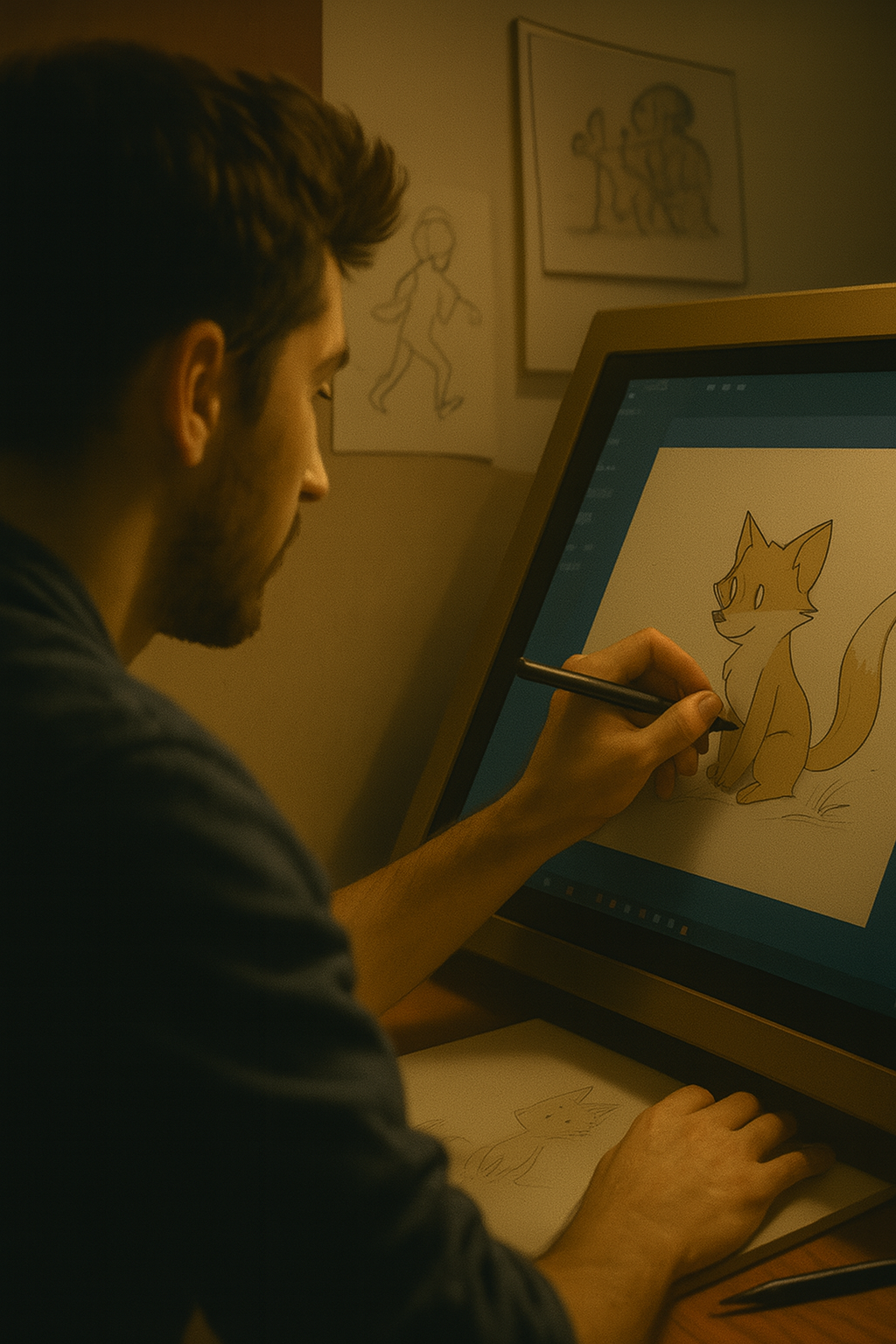
2D Animation’s Renaissance: Why Flat is the New Depth
For a while, 2D animation was dismissed as old-fashioned — a relic of an earlier era. As 3D surged to the forefront with dazzling realism and blockbuster appeal, many studios shelved their pencil strokes and ink wells in favor of polygons and shaders.
But quietly, and powerfully, 2D is rising again. At Portal Animation Studio, we’ve never stopped believing in it. And now the industry is catching up.
The Power of Style Over Simulation
While 3D strives for photorealism, 2D chases feeling. It has the power to stylize, simplify, exaggerate — and most importantly, to abstract truth through design.
Where a 3D face might twitch with precision, a 2D expression can stretch into metaphor. A teardrop can become a river. A character can grow older in a single brushstroke. 2D frees us from the literal — and leads us closer to the emotional.
New Tools, Same Heart
This renaissance isn’t nostalgic. It’s technological. Tools like TVPaint, Toon Boom Harmony, and Grease Pencil in Blender have breathed new life into frame-by-frame workflows.
- Rigged puppet animation for fluid repetition
- Parallax background movement for subtle depth
- Dynamic texture overlays for handmade grit
- Layered frame blends for motion emphasis
The result? Visuals that are both richly modern and deeply human.
Breaking Out of the Box
Today’s 2D doesn’t just live in children’s TV or indie shorts. It’s being used in:
- Adult dramas like Undone and Arcane
- Experimental films like Cryptozoo and The Spine of Night
- Feature animation like Klaus and The Breadwinner
Audiences are hungry for art that feels hand-touched. Personal. Imperfect in a way that invites empathy.
This new wave of 2D isn’t just “retro.” It’s rebellious — against photoreal sameness, against aesthetic fatigue.
Performance in Lines
There’s something sacred about drawing performance by hand. Animators become actors with pencils. Every frame becomes a choice — not interpolated by software, but sculpted by intention.
2D allows us to push a character’s inner world outward. A mood isn’t shown by just the face, but by the shape of the line, the weight of the silhouette, the color palette bleeding into the background.
This is why 2D continues to emotionally hit harder, even when it appears simple.
Where We’re Taking It
In our current projects, we’re blending 2D aesthetics into hybrid workflows — combining hand-drawn looks with real-time pipelines. We’re building tools that let animators sketch directly inside Unreal Engine, and designing filters that emulate brush-stroke motion blur.
We don’t see 2D and 3D as opposites anymore. We see them as instruments in the same band.